57 Meditations on Kicking @$$ in Business and Life"4.8/5 stars" on Amazon
What Does A Toastmasters Agenda Look Like?
Tweet 9 CommentsSome of you want to know what a typical Toastmasters meeting looks like.
Here’s a sample Toastmasters agenda (it assumes a 12:05pm start with a roughly 1pm close (total of 55 minutes for the meeting)).
- 12:05pm: Opening Remarks by Toastmaster (including mention of who Timer & Gramarrian are)
- 12:10pm: Speaker 1: [fill in their name, topic and number of minutes planned for speech]
- 12:17pm: Speaker #2 [fill in their name, topic and number of minutes planned for speech]
- 12:24pm: Table-Topics Leader introduces themselves & calls upon a handful of people to give 1 to 2 minute table-topic speeches
- 12:43pm: Master Evaluator introduces themselves & the speech evaluators:
- 12:45pm: #1 Evaluator introduces themselves and evaluates Speaker #1
- 12:48pm: #2 Evaluator introduces themselves and evaluates Speaker #2
- 12:51pm: Timer does their report (recording the time of each speaker)
- 12:52pm: Grammarian does their report (reporting on the Uhs, Ahs, Likes, Ya-Knows, etc. that each spekaer made)
- 12:54pm: Master Evaluator/ Closing/ Announcements
For more on Toastmasters basics, check out My First Experience With Toastmasters.
9 comments so far (is that a lot?) | Continue Reading »
Saturday, June 5th, 2010
The Top 10 “John Wooden” Searches On My Blog
Tweet 2 CommentsMy John Wooden Series is receiving a bunch of traffic these days after his recent death.
I always look at what keywords people search on to make sure I’m doing my best to provide good resources on them.
Towards that end, here are the top 10 John Wooden searche phrases (in quotes below) that I’m receiving, along with relevant links/answers:
- “john wooden quotes” — Here’s a good list of Wooden quotes (along with how many people like each one)
- “john wooden 7 principles” — This refers to the “7 Things To Do” that Wooden’s father taught him
- “john wooden steps to success” — Here’s my post on Wooden’s 8 Steps To Success
- “pyramid of success john wooden” — Here’s a cool image of Wooden’s Pyramid with
- “bill gates and john wooden” — my old colleague Bob Evans of Information Week wrote here that “Bill had a basketball autographed by John Wooden, the legendary UCLA basketball coach and a master strategist himself. I asked about the ball and Bill’s feelings toward Coach Wooden, but Bill just smiled and said we’d have to get to that another time.”)
- “john wooden records” (the best listing I can find of John Wooden’s records appears on this “John Wooden: A Coaching Legend Page at UCLABruins.com)
- “drink deeply in books’-wooden” (this is from Wooden’s father’s list of “Seven Things To Do” — the exact wording is “Drink deeply from good books, especially the bible.”)
- “best john wooden book for teenagers” — I believe that “Wooden: A Lifetime of Observations and Reflections On and Off The Court” is the best Wooden book for teenagers
- “charlie rose interviews john wooden” — Here’s a link to Charlie interviewing Wooden!
- “john wooden personality type” — I researched this and found out that he is likely an ENFJ and Enneagram Type 1
As you know, John Wooden is a hero of mine — if there’s anything else you’d like to know about him, please comment below.
2 comments so far (is that a lot?) | Continue Reading »
Friday, June 4th, 2010
John Wooden Quotes From “Pyramid of Success”
Tweet 5 Comments[This is part of a John Wooden Leadership Series I’m doing celebrating his 100th year of life]
The following is excerpted from John Wooden’s amazing book The Pyramid of Success.
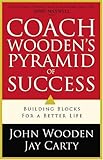
He begins with this overall quote:
“Success is peace of mind which is a direct result of self-satisfaction in knowing that you did your best to become the best that you are capable of becoming.”
And here are Wooden’s 15 “Building Blocks” of the Pyramid of Success along with quotes on each:
1) Industriousness — “There is no substitute for hard work. Worthwhile results come from hard work and careful planning.”
2) Enthusiasm — “Enthusiasm brushes off upon those with whom you come in contact. You must truly enjoy what you are doing.”
3) Friendship — “Friendship comes from mutual esteem, respect and devotion. Like marriage, it must not be taken for granted but requires a joint effort.”
4) Cooperation — “Cooperate with all levels of your co-workers. Listen if you want to be heard. Be interested in finding the best way, not in having your way.”
5) Loyalty — “Loyalty to yourself and to all those depending upon you. Keep your self-respect.”
6) Self-Control — “Practice self-discipline and keep emotions under control. Good judgment and common sense are essential.”
7) Alertness — “Be observing constantly. Stay open-minded. Be eager to learn and improve.”
8) Initiative — “Cultivate the ability to make decisions and think alone. Do not be afraid of failure, but learn from it.”
9) Intentness — “Set a realistic goal. Concentrate on its achievement by resisting all temptations and being determined and persistent.”
10) Condition — “Mental-Moral-Physical. Rest, exercise and diet must be considered. Moderation must be practiced. Dissipation must be eliminated.”
11) Skill — “A knowledge of and the ability to properly and quickly execute the fundamentals. Be prepared and cover every little detail.”
12) Team Spirit — “A genuine consideration for others. An eagerness to sacrifice personal interests of glory for the welfare of all.”
13) Poise — “Just being yourself. Being at ease in any situation. Never fighting yourself.”
14) Confidence — “Respect without fear. May come from being prepared and keeping all things in proper perspective.”
15) Competitive Greatness — “Be at your best when your best is needed. Enjoyment of a difficult challenge. “
5 comments so far (is that a lot?) | Continue Reading »
Thursday, June 3rd, 2010
Questions To Ask Employers (When You’re Interviewing For A Job)
Tweet 2 CommentsA friend of mine asked for my career advice the other day as he was preparing to interview for a job — I told him: turn the tables on your employer and ask THEM all the questions.
You may recall from A Simple 4-Step Approach on How To Sell Better (SPIN Selling), that I agree with the SPIN Selling approach in which you ask lots of questions to close a deal.
And this applies to a job interview in which you’re interviewing THEM as much as they are interviewing you.
Note: “Closing” the deal can include you closing it “out” (as in you don’t want to pursue the position)).
So, I rattled off these questions below. I suggest you immediately take control of the interview by saying something like: “Thank you for investing some time in me — would you mind if I began by asking a few questions about you and your business.
*Note: If any of these answers are available through research (e.g. on Web pages), you should research them ahead of time and skip asking them.
Questions To Ask Employers
Questions that Relate to the Person Interviewing You
- How do you get hooked up with the business?
- What are the top priorities for you right now?
- What are some key things I can take off your plate?
Big-Picture Questions To Ask Employers
- What are the top priorities for the entire business right now?
- How is the company structure organized (e.g. is it by department or by brand (with each brand having its own departments) and how does your team fit in?*
- What’s the “secret sauce” to how you make money (or create value)?
- Who are the shareholders/owners of the company? (Do any of them work at the company?)*
- Does the company have a purpose statement or mission statement?*
- Does the company have a set of company values — if yes, may I see a list of them?*
Performance, Compensation & Benefits Questions To Ask Employers
- How are priorities set? (e.g. within your group)
- How will you measure my performance?
- How does compensation work — is it just salary? Is there potential to earn bonuses or equity?
- What’s the company’s approach to work versus personal/family time ?
Questions To Ask Employers That Relate to Just You
- Who would my manager be and who do they report to?
- What is the company’s room for moving up the corporate latter?
- Are there any training opportunities I could potentially take advantage of?
I’ll add other questions to ask employers as I think of them…feel free to do the same in the comments section.
If you ask a lot of questions, and listen carefully, you’ll be in better shape to size up the job opportunity.
2 comments so far (is that a lot?) | Continue Reading »
Monday, May 24th, 2010
5 Tips On Managing Virtual Teams (From A Virtual CEO)
Tweet 7 CommentsVirtual team management is not easy.
It sounds great for everyone to wake up in their pajamas and crank out work all day…but the fact is that managing virtual teams has a whole other host of challenges.
But I’ve been through it…so enjoy these first-hand tips to maximize your effective virtual teamwork.
Tips For Managing Virtual Teams
1) Hold Daily Huddles
I recommend that meet with your virtual team daily (every other day at the least).
See my article entitled How The Ritz Carlton & I Run Our Meetings: The Daily Huddle for my approach to such huddles.
These huddles can be via conference call or video-conferencing if you can afford that.
The main reasons for frequent huddles (which can be 15 minutes or less) are:
- Speed — You will iterate faster
- Alignment — You and your team will better stay aligned on objectives
- Accountability — These meetings will hold you and your team accountable (it’s tough to hide poor performance when you meet daily or every other day)
2) Hold Periodic In-Person Meetings
For starters, for effective virtual team management, you’re still going to have to meet in person once in awhile.
If you are all in one country, I recommend you meet in person every other month — if that is not doable, I recommend you meet quarterly.
These in-person meetings are vital for such things as:
- Setting longer-term goals — E.g. 3 year, 1 year and 3 month goals.
- Virtual team building — Last I heard you can’t give hugs or high-fives over the Web!
- Tackling discussion items that require 2 to 8 hours — Doing these virtually (i.e. over the phone) will be very stressful (especially since you and your team are already spending a lot of time on the phone)
- Zoom-Out brainstorming — When you work virtually you tend to to be “zoomed-in” much of the time — you’ll need to leave your virtual workplace to zoom out on bigger picture/strategy items.
3) Use Document/Screen Sharing Programs — “Get on the same page!”
One of the biggest risks in virtual teamwork is that you and your team fall off the same page.
To help prevent that, I recommend you use such tools as:
- Google Docs — This allows you to collaborate on word processing, spreadsheet and presentation documents together
- ScreenShare Programs — These programs are are easy for showing your colleague what’s on your screen (screen-sharing programs I’ve used that I recommend include Mikogo, Join.me , the screen-sharing feature within Skype or Microsoft’s Live Meeting (all but Microsoft’s are free).
4) Hold A Regular Company-Wide Telephone Call
If you have multiple virtual teams (or your company is 100% virtual like ours), then I recommend that you hold a “Team Call” once or twice a month.
Topics for the team call can include:
- An update on financials
- An update on meeting objectives
- Training the team on a skillset (perhaps how to use Google Docs, Mikogo or Live Meeting)
- Praising team members for good work
- Celebration of birthdays or anniversaries
5) Communicate Through The Appropriate Medium
Virtual team communication can be quite challenging…afterall, you can’t typically see another person’s expression or body language when you’re in a virtual office environment.
My general rule of thumb is that the more sensitive the topic to discuss, the higher the bandwidth communication you should use.
Here are examples of discussion topics and the communication method I recommend you consider:
- Updates on product sales — Email is ok
- Updates on a change in a company policy — Telephone preferable/email ok
- If an employee is under-performing — Telephone is preferable (backed up by email)
- Bad financial news — Telephone is preferable
- If an employee needs to be let go or fired — In person is preferable/telephone is next best option (don’t do it via email!)
Leading virtual teams can be fun and rewarding…you just have to realize that it’s going to require some different approaches than working with your team in-person.
You’ll be mastering virtual teams before you know it!
If you liked this article, you may want to check out my article on Virtual Team’s Pros & Cons.
7 comments so far (is that a lot?) | Continue Reading »
Sunday, May 23rd, 2010
7 Tips On How To Motivate Your Team (Hint: Make Them Feel "Progress")
Tweet 4 CommentsA feeling of “progress” may be the most important motivator for you or your team, according to a Harvard Business Review study on what motivates people (thanks to my colleague Mary for pointing this one out).
The HBR study took an interesting angle on motivation by studying hundreds of workers and digging into what happens on a great work day.

The gist of the study is that on days when workers feel like they’re making progress on projects their emotions are positive and that increases their drive to succeed.
The opposite is true: when workers are feeling like they’re on the “hamster wheel,” working hard with little in the way of results, they feel negative emotions and their performance plummets.
And the progress that your team feels can even be small…and they’ll still feel motivated!
7 Tips For How To Motivate Your Team Through Progress
1) Set SMART Goals
To motivate your team through the feeling of progress, you’re gonna first need to work with them to set goals.
The goals you set should be SMART Goals:
- Specific — Well defined, clear to everyone
- Measurable — There should be a metric or some measurement to identify how you’re progressing on your goal.
- Agreed-Upon — The goal should be agreed upon by the people working on it.
- Realistic — The goal can be ambitious but should be within reason
- Time-based — Every goal should have a time-line.
2) Provide Resources Necessary to Achieve Goals
You as a leader should do whatever you can to provide the resources necessary for your team to work on reaching goals.
Spend 1-on-1 time with them to discuss the goals and ask them what they need to reach them.
3) Hold Frequent Meetings To Chunk Down Goals
Let’s say you’ve got your team’s quarterly goals in place.
Now you’re gonna want to set up frequent meetings within the quarter to discuss them.
I recommend that you meet with your team either daily (or every other day) (see Daily Huddle).
In those huddles, ask your direct report to list things that they could do in THAT WEEK to make progress on the quarterly priorities.
E.g. If your quarterly goal is to close a major partnership with a single Fortune 100 customer, then ask your direct report at the start of a week what is it that they can commit to doing to moving that priority forward.
Example of chunking down the quarterly goal:
- If it’s the beginning of the quarter, the first week’s goal may be as simple as committing to identifying the 10 Fortune 100 customers your direct report is going to go after.
- The following week’s goal may be to telephone a contact at each of the ten Fortune 100 customers.
- In the week after that, your direct report may agree to commit to making a proposal to a certain Fortune 100 customer.
- Etc.
Now, as your direct report makes headway on these chunked-down goals, they will have a feeling of progress.
Remember this nugget of wisdom from my business hero Coach John Wooden (I’m paraphrasing):
Progress is not necessarily reaching your goal…progress is working as hard as you reasonably can on your goal and then letting the results be what they may.
4) Celebrate Milestones
When you reach your goals (i.e. milestones), take a moment to celebrate.
Acknowledge each and every person involved in the project…ideally with specifics on what they contributed to its success.
As a CEO, I ask my team to remind me of whenever anyone does something impressive…and then I try to write a quick congratulatory note to that team member (cc:ing their manager).
5) Acknowledge Failure As Progress
Don’t forget that failure is progress.
For example, your team may have a goal of trying to close certain types of customers or partnerships. If you explore one such deal and it’s not a good fit (for you or the other party), that is still progress.
Remember the old adage about the vacuum salesperson who realizes he has to knock on 50 doors before he makes a sale of one $50 vaccum:
“Each failure (closed door) is worth a dollar!” (because he gets $50 for knocking on 50 doors)
So when someone slams the door shut on a component of your goals, just move on — cuz you’re that much closer to getting what you want.
6) Be Authentic
This one’s easy: your praise of people should always be authentic.
Don’t tell someone they “really moved the ball forward” when you actually don’t know what they did.
7) Be Decisive
If you as a leader are indecisive about decisions around goals and priorities then you delay the feeling of progress that your team gets when they either reach (or fail to reach) their goal.
Progress is tough to feel when leadership is wishy-washy.
So be decisive about such things as:
- Setting goals
- Providing resources to help the goals get reached
- Pulling the plug on deals/losing deals (once in awhile you will either want to pull the plug on a deal or you will have it pulled for you by another party — this is ok, just make it fast).
If you can work on the above 7 tips, you will help motivate your team though progress.
4 comments so far (is that a lot?) | Continue Reading »
Saturday, May 22nd, 2010
How To Determine Your Business Values: Exercises, Examples & Top Lists
Tweet 3 CommentsDo you know what your business’s values are?
I believe that your corporate values may be THE most important asset in enhancing your company’s long-term monetary value.
Your strategies and trends will come and go — your values can be forever!
This article will help answer the top questions you need to know about corporate values, such as:
- What are values?
- Why are values important?
- How do you determine your values (including a “values exercise”)?
- What are some business examples of values?
Here we go…!
What are values?
My definition of values is simple: Values are deeply-held beliefs about the right way of doing things.
Each individual operates life with their own set of values…and, of course, a business should as well.
Why are values important to a business?
As the author Jim Collins penned:
“The founders of great, enduring organizations like Hewlett-Packard, 3M, and Johnson & Johnson often did not have a vision statement when they started out. They usually began with a set of strong personal core values…”
It is your values that will guide you through the toughest decisions you make…you know, those 50-50 calls that every business leader faces periodically.
How do you determine your business values?
Here’s an easy values exercise Jim Collins suggests (with my own twists on it after going through a couple):
- Sit down with your team.
- Imagine that you need to create a mini-version of your company on Mars…
- …And you have to send a few people (up to 7) from your company on a spaceship to Mars to represent your business’s best attributes.
- Identify the handful of employees you’d send on the spaceship (you can’t vote for yourself (and, ideally (if your company is large enough), you aren’t allowed to select anyone on the team doing the exercise)
- Now examine those people that your team identified and list out the values/attributes they possess that made you vote for them (e.g. Jane operates with integrity,Ralph strives for excellence, etc.)
- You should have a list of 10 or more business values at this point
- Start poking holes at each business value (you can use real-life business challenges/successes to test each business value to see if it is indeed true)
- Some values might be redundant with each other so start shrinking your list (I recommend you get it down to 8 or fewer values)
- Wordsmithing — Once you come up with the list of 8 or fewer values you may want to wordsmith them in a way that’s more of a commitment
Examples of Business Values
There are numerous examples of business values out there — here are a few of companies I’m familiar with:
Hot Topic Media’s Values — Here’s an example of values our team came up with:
- We treat our customers, partners & employees with dignity and respect
- We do what we say, and we own what we do
- We give our customers more value than they expect
- We are good shepherds of our company’s assets
- We leave the world a better place than we found it (the “Campsite Rule”)
- We are proud of what we do and have fun doing it
- We keep things simple and clear
Google’s Values — Google has a version of values it calls “Our Philosophy: Ten Things We Know To Be True”
- Focus on the user and all else will follow
- It’s best to do one thing really, really well
- Fast is better than slow
- Democracy on the web works
- You don’t need to be at your desk to need an answer
- You can make money without doing evil
- There’s always more information out there
- The need for information crosses all borders
- You can be serious without a suit
- Great just isn’t good enough
Hewlett Packard’s Values — HP Calls these their “Shared Values”:
- Passion for customers — We put our customers first in everything we do.
- Trust and respect for individuals — We work together to create a culture of inclusion built on trust, respect and dignity for all.
- Achievement and contribution — We strive for excellence in all we do; each person’s contribution is key to our success.
- Results through teamwork — We effectively collaborate, always looking for more efficient ways to serve our customers.
- Speed and agility — We are resourceful, adaptable and achieve results faster than our competitors.
- Meaningful innovation — We are the technology company that invents the useful and the significant.
- Uncompromising integrity — We are open, honest and direct in our dealings.
BabyCenter’Values — Johnson & Johnson subsidiary BabyCenter calls it these their “Operating Principles”:
- Operate with Integrity — Always
- Our Sucess Starts with Our People
- Be Customer-Driven
- Strive for Excellence
- Work Together to Make Decisions
- Everyone Needs Feedback
- Respect One Another
- Face Facts Constructively
A final point: values aren’t just something to write down (or put on a coffee mug as some do).
Values must be based on the real-life actions of a business.
And it starts with leadership — exemplifying their values through their actions and decisions.
3 comments so far (is that a lot?) | Continue Reading »
Friday, May 21st, 2010
How One Biz Used A Free Coke To Get 25,000 Facebook Leads (Real Leads with Physical/Email Address!)
Tweet 10 CommentsIf you want to generate free leads on Facebook, Scott Crider is someone you should listen to.
He’s been preaching the benefits of creating value through social media for a few years now.
Back in 2007 Scott built the Dogs Against Romney blog after hearing Presidential hopeful Romney tell a reporter about how he had once strapped a dog cage to the roof of his car (with his dog in it!) on family vacation, traveling 80MPH…scaring the dog so badly that it shit all down the side of the car.
Dogs Against Romney was an overnight viral success picked up by major media outlets — it generated at least 500,000 visits in less than a month.
Scott also helped his friend and Presidential candidate Mike Huckabee get hundreds of thousands of free Web site visitors during his campaign.
If Elvis Presley were still alive, he’d probably be asking Scott for help monetizing Facebook (Scott’s firm, Aristotle Interactive, handles email marketing for Elvis Presley Enterprises).
Scott and the Aristotle team had a recent win helping a business generate leads through Facebook.
I asked him a few questions about lead gen win and general subject of making money through Facebook — enjoy!
Q: Would you explain how a business begins to think about making money through Facebook?
The real power in Facebook is in turning people into advocates for your brand, and you do that by giving them something of value, in a cool way, and making it easy for them to share.
Q: What is your definition of a Facebook app?
My definition of a Facebook app is one that requires the user to grant permission for it to access their personal information, and everything has to function within the Facebook API (the user never leaves Facebook).
Q: Tell me about Murphy USA — how did you help them acquire Facebook leads?
Murphy USA is a Fortune 100 gas station-convenience store chain, and a great client that lets us do great work.
They tasked us (Aristotle Interactive) to come up with a way of helping them grow their fans from their then-level of 5,100 (many of whom were associates of the company) to a much higher number of customers, and to activate those customers to visit their stores.
Q: So what was your approach?
We created a custom app for them that offered both existing and new fans a free Coca-Cola product of their choice, to be picked up at any Murphy USA location, and the app also allowed everyone to who got a free Coke to share one with their friends, as well.

The app collected both email and physical addresses, as well as age info (a Facebook requirement) from the customers, and delivered the free Coke in the form of a secure, printable coupon to their email address.
Q: Can you walk us through the steps that a user would experience in this app you built?
- Well, first off, existing fans of the Murphy USA Facebook page (about 5,100 people) were the first to see the new custom tab on Facebook that said “Help Murphy USA share 100,000 Cokes!”
- After launching the app and getting their own coupon, fans were then presented the message “Your free Coke is on its way. Now share one with your friends!” The app, still running within the Murphy USA Facebook page, then presented the customer with his or her complete friends list, and they could select up to 12 people to share the promotion with (a Facebook restriction).
- Each of the 12 people the promotion was shared with then got a message in their Facebook inbox from their friend that said “You have a Murphy USA coupon invitation.”
- The message linked the person directly to the Murphy USA page where the default tab was set to the promotion.
- The fan was asked to “Show us you like us!” (click the “Like” button on Facebook, launching the app) and the process started all over again.
Q: Were there other ways the app you built encouraged Facebook fans to spread the word?
Yes, in addition to choosing 12 friends to share the promotion with, the app also offered each person the opportunity to post a message to their news feed that said “I got a free Coke from Murphy USA!” which could be seen by everyone.
Q: On average, how many friends did each Murphy USA fan share the app with?
I’d estimate that most of them shared it with all 12 friends they were allowed to share it with, and posted the message to their news feeds as well.
Q: So, that would mean that perhaps two thousand of Murphy USA’s fans shared the app (the free coke coupon) with 20,000 of their friends?
It’s hard to say. It went viral extremely quickly. Literally within minutes. The first two days the app was live they grew by 7,000 new fans each day.
It was so much traffic that our outbound coupon email volume to AOL caused them to temporarily block us and we had to put some bottlenecks in to slow it down. It was something like 800 AOL emails in an hour that triggered it. I didn’t even know 800 people still used AOL!
So far, the app has taken them to over 32,000 fans in 3 weeks since it launched, and virtually 100% of them have stayed as fans.
How much does an application like this cost to build?
I probably shouldn’t reveal any figures on that, because the client is in a very competitive business and they’re pretty tight-lipped about things that give them an advantage. Let’s just say that it cost less than you might think. It easily fit within their normal quarterly promotions budget.
How does Murphy USA use the email address they now have for their 30,000 + new fans for marketing follow-up?
Murphy USA really respects people’s privacy, so they chose to send one follow up email message to them to offer them the opportunity to opt into Murphy’s monthly e-Offers (an opt-in email database that offers promotions on all the different things they sell).
Of course, nearly all 30,000+ of them are still fans of Murphy’s Facebook page, too, and can be communicated with there anytime.
How would you describe Murphy’s ROI on this?
I’d say the return on their investment has to be pushing 1,000+%, probably more, considering the lifetime value of these new relationships.
Will Murphy USA do more of these free coupons?
I’m sure they will. Re-skinning the app and replacing the coupon is fairly easy, plus it’s a win/win for Murphy USA and their product partners.
Q: What did Aristotle do to ensure security for all this (i.e. make sure there’s not an unlimited # of free coupons that people use)?
That was another level of complication in the app creation, but a necessary one to protect both the client and Coca-Cola.
We built a system that generated a custom coupon for each recipient. They received an email with a one-time link to the coupon, and each coupon had the recipient’s email address screened across the entire face of it. So they could only access it once, and they were discouraged from making copies.
Q: Can you give me another example of a business that could do really well with a free giveaway on Facebook?
Imagine Victoria’s Secret — if they launched something like this as a “share a free panty with your friends” on Facebook, it would go stratospheric. Are you listening Victoria? Call me (ha!).
Q: So, if you had to sum up the keys to making one of these Facebook marketing apps work, what would it be?
Three things:
- Share something of value – a coupon, good content, a fun digital experience
- Do it in a cool way and make sharing easy
- Let the customers who share it look good to their friends
Q: That’s a fascinating use-case, Scott — If someone were to want to get in touch with you or Aristotle Interactive, what’s the best way for them to do so?
They can call me at Aristotle Interactive at 501-374-4638, or hook up with me on Twitter @CScottCrider or here on Linked In.
10 comments so far (is that a lot?) | Continue Reading »
- AI (1)
- Analytics (5)
- Blogging (13)
- Career Advice (10)
- Communication (10)
- Decision Making (3)
- Design (3)
- Entrepreneurship (24)
- Fun (1)
- Fundraising (8)
- Getting Things Done (20)
- Health (4)
- Hiring & Firing (7)
- Hot Startups (9)
- Increasing Sales & Profit (9)
- Increasing Web Traffic (15)
- Leadership (34)
- Marketing (24)
- Meetings (3)
- Mental Models (12)
- Networking (12)
- Personal Development (12)
- Psychology (6)
- Publishing (4)
- Quotes (10)
- Selling Your Business (2)
- Social Media (14)
- Software (1)
- Teamwork (5)
- Uncategorized (4)
- Virtual Business (2)
- Wall Street & The Economy (8)
- Work Environment (1)
- June 2024 (1)
- December 2019 (1)
- October 2017 (1)
- May 2014 (1)
- April 2014 (1)
- March 2014 (3)
- February 2014 (2)
- January 2014 (1)
- July 2013 (2)
- April 2013 (1)
- March 2013 (2)
- January 2013 (1)
- December 2012 (4)
- September 2012 (1)
- July 2012 (3)
- April 2012 (1)
- November 2011 (2)
- October 2011 (4)
- September 2011 (4)
- August 2011 (1)
- July 2011 (4)
- June 2011 (7)
- May 2011 (8)
- April 2011 (10)
- March 2011 (10)
- February 2011 (7)
- January 2011 (1)
- December 2010 (5)
- November 2010 (6)
- October 2010 (6)
- September 2010 (1)
- August 2010 (3)
- July 2010 (7)
- June 2010 (12)
- May 2010 (6)
- April 2010 (9)
- March 2010 (10)
- February 2010 (8)
- January 2010 (11)
- December 2009 (4)
- November 2009 (11)
- October 2009 (8)
- September 2009 (4)
- August 2009 (3)
- July 2009 (5)
- June 2009 (7)
- May 2009 (18)
- April 2009 (10) → Click Here To View All Post Headlines
